

Multi-Layer Financial Enterprise Architecture
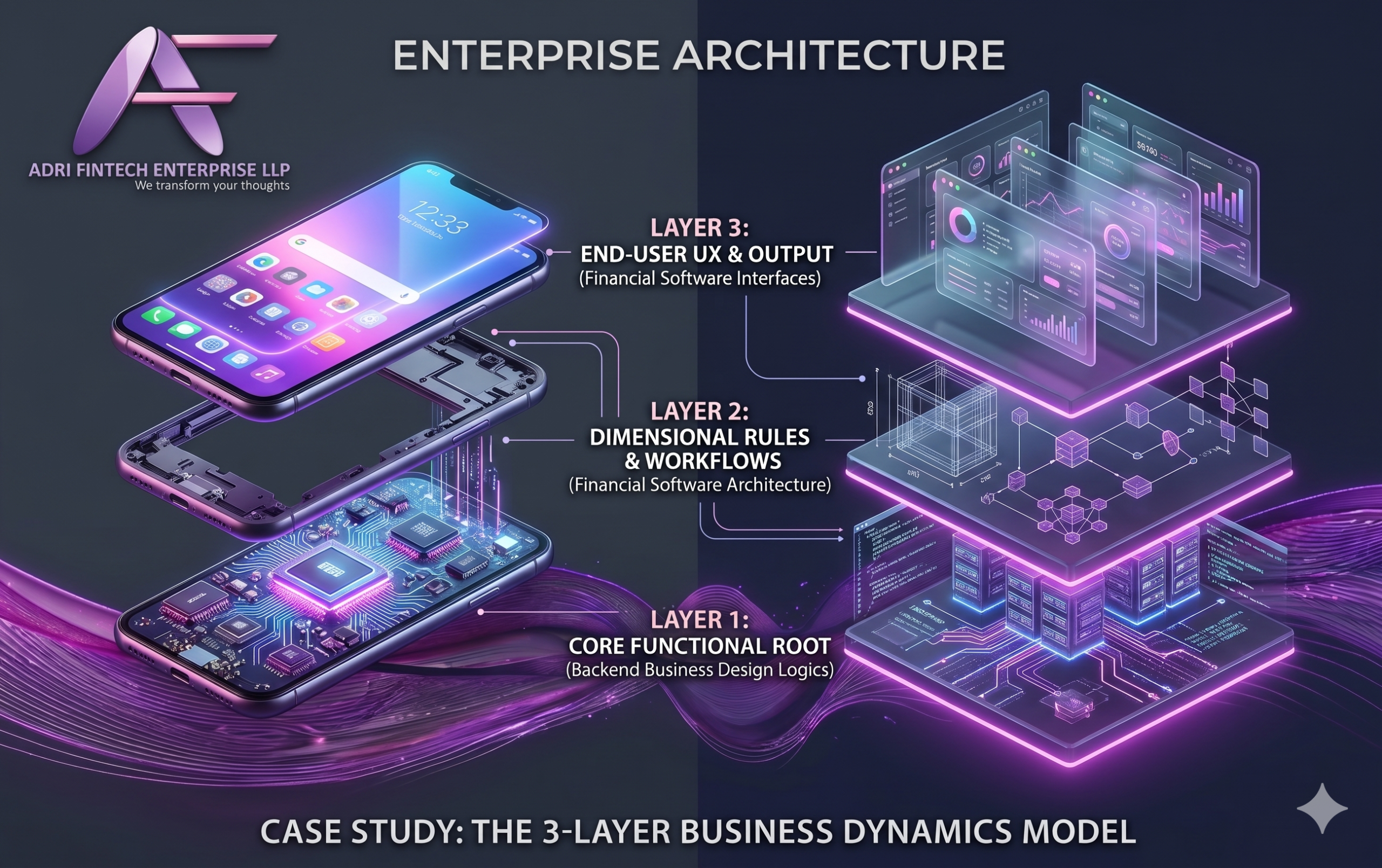
A Comparative Business Dynamics Case Study & Intellectual Property Framework Using the Smartphone Hardware-to-Experience Analogy
Case Study Context & Architectural Premise
In modern financial technology, stakeholders frequently mistake visible application screens for the
entirety of a software system. This case study examines the enterprise architecture model established
for AdriFintech Enterprise LLP, demonstrating why sustainable financial software cannot be
engineered as a flat, surface-level tool. Instead, financial enterprise architecture operates as an
interdependent, multi-layer business dynamics model.
To clarify how invisible engineering governs visible performance—and to establish clear boundaries
for proprietary ownership—AdriFintech Enterprise LLP aligns its financial enterprise architecture
with the engineering hierarchy of a Samsung smartphone. Just as a smartphone relies on the
seamless unity of its internal motherboard, structural phone design, and user-facing operating
software, AdriFintech’s platform integrates backend business logics, dimensional workflow models,
and load-bearing end-user screens.
The Three-Layer Business Dynamics Model
Layer 1: Backend Business Design Logics (The Core Functional Root)
At the foundation of AdriFintech Enterprise LLP’s enterprise architecture lies a deep understanding
of backend business design logics. These business logics act as the core functional root of the entire
financial ecosystem. Every rule of value movement, financial validation, ledger state, and operational
dependency originates here before a single workflow or visual interface is rendered.
In the consumer hardware analogy, Layer 1 corresponds directly to the internal hardware board of
a Samsung smartphone. This board carries the motherboard and all integrated microchips
beneath the surface that power computation, memory, and connectivity. Although unseen during
everyday operation, nothing on the surface of the device can function without the integrity of this root
circuitry.
Layer 2: Structural Software Architecture, Dimensional Rules & Deep Workflows
Building directly upon the backend root, Layer 2 governs the structural architecture of the platform.
Within AdriFintech Enterprise LLP, this is the tier where financial software is engineered using
dimensional rules, domain logics, and structured data models, which then extend into deep, multistage
operational workflows.
In the smartphone analogy, Layer 2 represents the physical phone design and internal
structural engineering. Phone design is directly associated with hardware architecture: it
organizes, shields, and channels the capabilities of the motherboard into a coherent structural form.
Similarly, Layer 2 translates raw financial business logics into disciplined structural models and
repeatable enterprise workflows.
Layer 3: End-User Output & Load-Bearing Financial Screens
Layer 3 focuses on end-user output and operational interaction. Just as Samsung software
delivers the end-user experience on the screen of the phone, AdriFintech’s Layer 3 delivers
financial software end-user screens where operators, analysts, and clients execute decisions and
review outcomes.
Within this case study, Layer 3 is recognized as a critical architectural tier rather than a cosmetic
shell. End-user financial screens carry the cumulative operational load of the underlying software
execution, structural design integrity (Layer 2), and core financial business logics (Layer 1). Any
weakness in root logic or structural workflow immediately surfaces as friction or failure at the user
screen
| Architectural Tier | Samsung Smartphone Analogy | Adrifintech Architecture Layer | Operational Role & Load Dynamics |
| Layer 1 Core Root | Internal hardware board carrying the motherboard and integrated chips beneath the surface. | Backend business design logics serving as the core functional root of the enterprise model. | Establishes foundational computation, financial rules, and root operational truth that make surface operations possible. |
| Layer 2 Structural Design | Physical phone design and structural chassis directly associated with device architecture. | Financial software architecture built with dimensional rules, logics, structural models, and deep workflows. | Organizes root business logics into governed multi-dimensional rules, structured pathways, and deep process execution. |
| Layer 3 End-User Output | Samsung software environment delivering the visible, interactive end-user experience. | Financial software end-user screens and operational output interfaces. | Carries the combined load of software execution, structural design integrity, and backend financial business logics. |
- Case Study Findings: Structural Integrity & Load Transmission
Evaluating AdriFintech Enterprise LLP through this three-layer lens highlights three essential
architectural principles for enterprise governance and system evolution:
Root-First Engineering: Modifying an end-user screen without aligning Layer 1 backend
business design logics is equivalent to altering a smartphone display without motherboard
support; sustainable financial capabilities must always originate at the functional root.
Workflow Coherence via Dimensional Rules: Deep financial workflows remain resilient
only when anchored in Layer 2 dimensional rules and structural models, preventing ad-hoc
operational workarounds.
Cumulative Interface Responsibility: Because Layer 3 end-user screens bear the full load of
software performance, design integrity, and financial business logic, interface design must be
treated as a high-integrity engineering discipline.
Intellectual Property Rights (IPR) Governance & Clause
INTELLECTUAL PROPERTY RIGHTS CLAUSE — ADRIFINTECH ENTERPRISE LLP
- Whole-Stack Proprietary Ownership: All intellectual property rights, trade secrets,
architectural models, copyrights, and proprietary know-how subsisting in the financial enterprise
architecture belong exclusively to AdriFintech Enterprise LLP. By way of architectural analogy
to a Samsung smartphone—wherein proprietary protection is never restricted solely to the outer
screen, but encompasses the internal hardware board housing the motherboard and chips, the
physical phone design associated with its architecture, and the user-facing software experience—
AdriFintech Enterprise LLP’s intellectual property covers the entire Multi-Layer Business Dynamics
Model as an indivisible proprietary work. - Layer-Specific Protection Scope: Proprietary ownership strictly encompasses: (a) Layer 1
Root Assets, comprising all backend business design logics and core functional roots analogous to
the motherboard and chip assembly; (b) Layer 2 Architectural Assets, comprising all dimensional
rules, operational logics, structural models, and deep financial workflows analogous to the structural
design of the phone; and (c) Layer 3 Output Assets, comprising all end-user financial screens and
experience outputs carrying the cumulative load of software, structural design integrity, and
financial business logics. - Prohibition on Reverse Engineering & Derivative Extraction: Access to or viewing of
Layer 3 end-user screens grants no license, right, or authorization to copy, deconstruct, reverseengineer,
replicate, or create derivative works from Layer 2 dimensional workflows or Layer 1
backend business design logics—just as operating a Samsung smartphone’s user interface confers no
right to appropriate its internal motherboard circuitry, chip architecture, or industrial design.